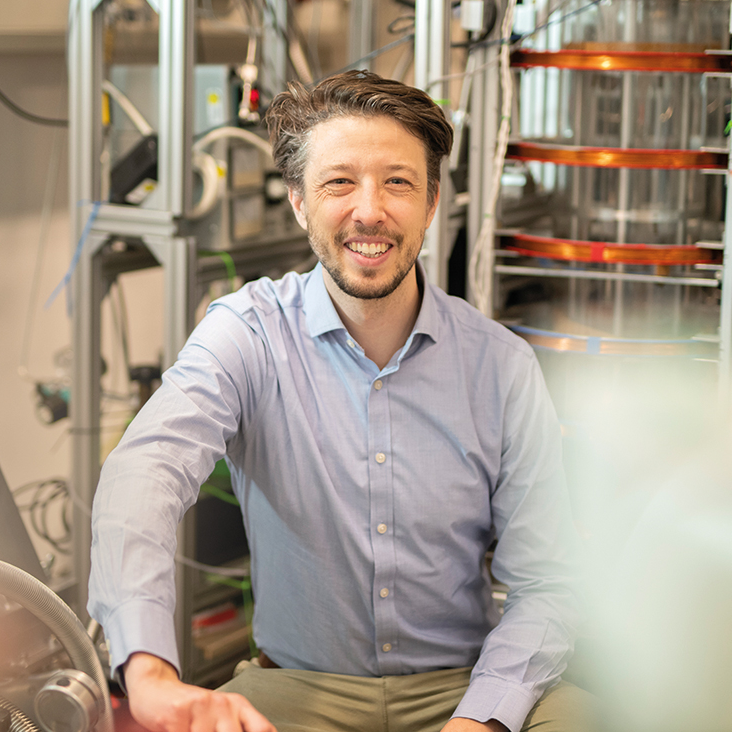
“Shortly before Christmas, we decided: Now we are ready! And indeed, we were able to carry out a first measurement with our new setup to search for dark matter. The fact that this 20-hour measurement worked so well after several years of development is a real milestone. But we have also learned a lot – and hope that we can make the next development leap within another year. For example, much longer automatically controlled measurements should then be possible.”
Our experiment is called CASPEr, which stands for “Cosmic Axion Spin Precession Experiment.” It is an international research program with several setups worldwide, for example at Boston University in the USA. What all the experiments have in common is that we use nuclear magnetic resonance technics to detect dark matter – in this case, we are looking for extremely light particles as promising candidates for dark matter, the so-called axions.
All CASPEr setups complement each other in that they each make different mass ranges accessible in which we can search for axions. Our current Mainz setup is called “CASPEr-gradient low field” and since I came to Mainz in 2020, as head of the junior research group, I coordinate the work on the experiment and supervise master’s degree and doctoral theses.
My motivation: to apply technics that we develop in experimental atomic physics to fundamental questions of physics. Dark matter is certainly right at the top of the list, which is what makes the CASPEr project so exciting. The scientific exchange about our research is no less important: The MITP as an international center offers me the ideal concept to be able to discuss the biggest puzzles of modern physics on site in Mainz with many international guests.”
Dr. Hendrik Bekker is head of the junior research group in Prof. Dr. Dmitry Budker’s research team. In 2020, he came to Mainz from Columbia University in New York. The search for dark matter particularly fascinates him. In the meantime, there is a lecture on the subject specially designed by him for master’s degree students
Photo: Angelika Stehle