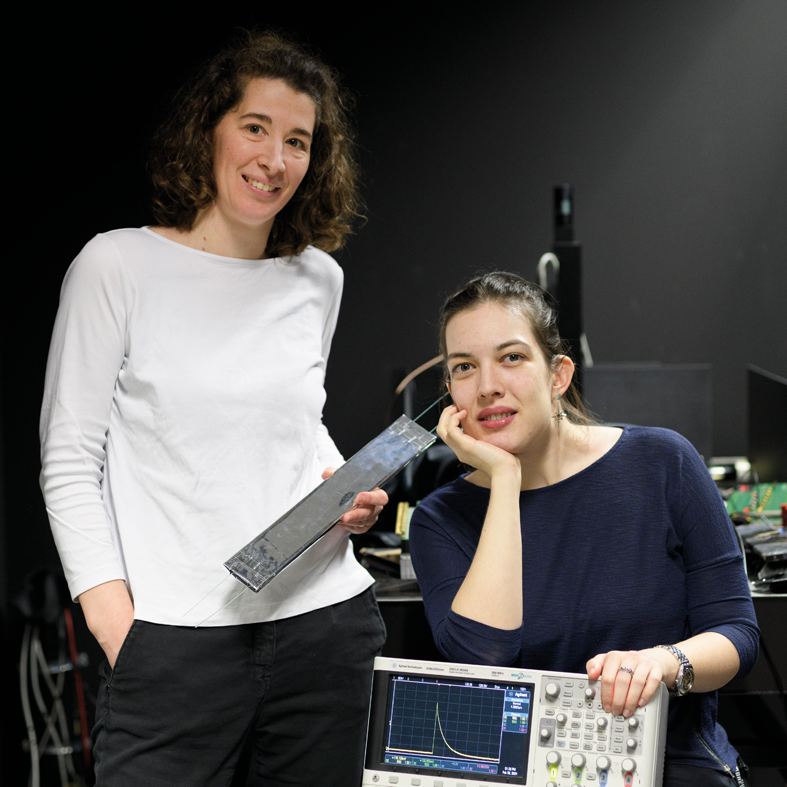
“I’ve known CERN since I was a child,” says Célia. “It was already my parents’ workspace.” Letizia is also very familiar with the organization: “I was there in 2015 as part of the Mainz team that installed the NA62 experiment’s hadron calorimeter, and I stayed for six months for data acquisition.”
Letizia has almost 10 years of experience in the NA62 collaboration, while Célia has just started her doctorate studies. However, both share a passion for Particle Physics and an interest in experiments that measure particles and their properties. “I knew from the beginning that I wanted to work in Particle Physics,” says Letizia. “During my bachelor’s thesis, I became familiar with the experimental side of Particle Physics, and when I started performing data analyses and simulations for existing experiments, I knew this was the right path for me.” “I also fell in love with Particle Physics,” Célia adds, “and the more I learned, the more I liked it. But unlike Letizia, I like to build things and see how the individual parts come together to form something concrete and tangible – a detector that can measure particles. But I also enjoy data analysis, because it allows you to evaluate and improve the performance of such detectors.” Since Célia joined Dr. Rainer Wanke’s group, they have been working together on two main goals: the analysis of NA62 data and the preparation for the construction of scintillator calorimeters for future experiments at CERN.
The NA62 experiment has a comprehensive program in kaon physics, aiming to investigate the effects of new physics through both precision measurements and the search for rare and forbidden decays. “By analyzing the data from the first cycle, 2016–2018, we obtained indications of the decay of kaons into pions and neutrinos,” explains Letizia. “After upgrading the detectors and triggers, the second run began in 2021, which is approved until the next long shutdown of CERN.” During these years, the entire collaboration works together. “NA62 is a small collaboration, especially compared to others at CERN,” Célia emphasizes, “and that’s great for me because it gives me the opportunity to closely follow all steps of the experiment and learn from all my colleagues.”
Dr. Letizia Peruzzo (left) obtained her doctorate in Dr. Rainer Wanke’s work group, where she has been active since 2014. Célia Polivka (right) began her doctorate in the same group in September 2023, after completing her master’s degree in Lausanne.
Photo: Angelika Stehle