Groundbreaking experiment at CERN with expertise from Mainz
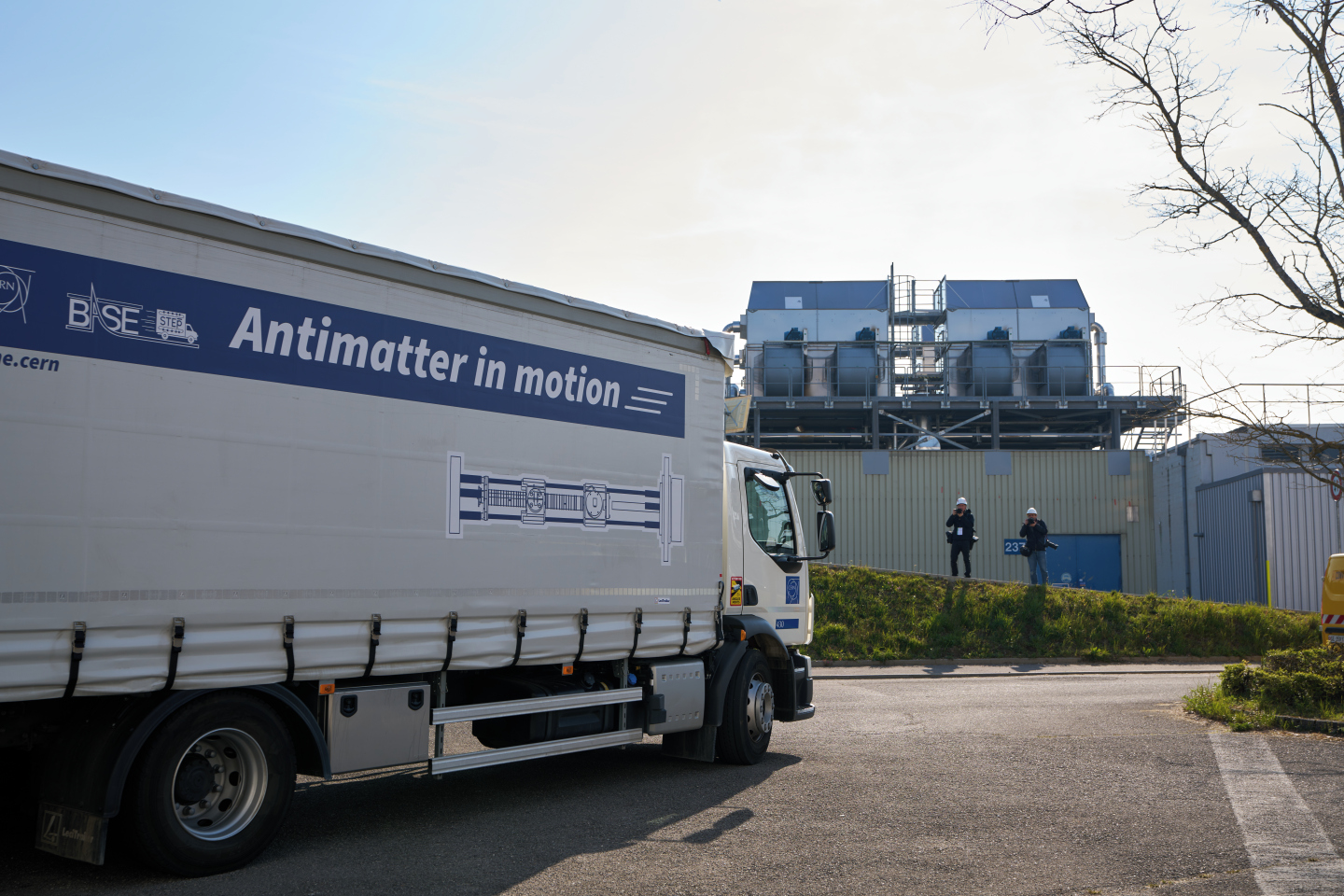
For the first time, antiprotons were transported across the grounds of CERN in Geneva today in a specifically constructed trap. This world premiere is a major success for the BASE research collaboration, led by Prof. Dr. Stefan Ulmer of Heinrich Heine University Düsseldorf (HHU). It marks the first step towards transporting antimatter to other laboratories across Europe. For example, researchers from the PRISMA++ Cluster of Excellence at Johannes Gutenberg University (JGU) Mainz are currently developing afacility in which positrons and antiprotons are to be “captured” together and studied.
The antiprotons were produced at CERN’s “Antimatter Factory” (AMF), the world’s only facility capable of generating these specific particles at particularly low energies, the research team from BASE (Baryon Antibaryon Symmetry Experiment) has now succeed in trapping a cloud of about 100 antiprotons in a portable device known as a Penning trap. This trap was then disconnected from the stationary experimental facility, loaded onto a truck, driven across the CERN campus, and finally reconnected to the experimental facility so that the antiprotons could be fed back into the system.
Dr. Hendrik Bekker, a researcher at the Helmholtz Institute in Mainz: “It is very difficult to trap antiprotons and store them for any length of time. This is because antimatter decays immediately upon coming into contact with matter, such as gas particles or the storage vessel itself. To store it safely, therefore, strong electric and magnetic fields as well as an extremely high vacuum are required.”
But why go to all this trouble? The BASE collaboration aims to measure the properties of antiprotons – such as their intrinsic magnetic moment – precisely and compare these measurements with those of the proton. BASE has long held the record for storing antiprotons for more than a year in its stationary setup at the AMF.
In order to achieve the precision needed, however, the physicists face a problem: The AMF’s particle accelerators generate ripples in the magnetic field which restrict the precision of measurements. “To achieve a deeper understanding of the basic properties of antiprotons, we need an environment with less interference fields. That means we need to move, for instance to our laboratory for high-precision antiproton measurements, which is under construction at HHU. This why we started development of a movable trap about ten years ago, led by Christian Smorra”, says Prof. Dr. Stefan Ulmer, spokesperson for BASE and holder of the Chair of Quantum Technology and Fundamental Symmetries at HHU. Early development of the trap took place at JGU Mainz. The world premiere at CERN is an important test for the idea of moving antiprotons: It shows the technical feasibility of moving them to different European laboratories.
“To this end, we have developed the portable BASE-STEP trap to transport the captured antiprotons to precision laboratories at various locations: within CERN, to HHU, Leibniz University Hannover, and possibly to other laboratories. “That is where the extremely precise antiproton measurements will be carried out,” explains Dr. Christian Smorra, a member of Ulmer’s Düsseldorf research group and the leader of the STEP project funded by the European Research Council (ERC). “Last year, we already confirmed the feasibility of our concept using protons. Now we have achieved the same with antiprotons. That is a huge leap toward our goal.”
BASE-STEP captures the antiparticles using magnetic and electric fields. The apparatus weighs about 850kg, can be loaded onto trucks, fits through standard laboratory doors and withstands the shocks and vibrations of road transport. It combines a superconducting magnet, cryogenic cooling system using liquid helium, power reserves, and a vacuum chamber in a uniquely compact package when compared to other systems for studying antimatter.
“To date, we have stored antiprotons loss-free in BASE-STEP for two weeks and can transport the trap autonomously for four hours,” says Smorra. “However, to reach our laboratory at HHU, it would take us at least ten hours. This means we’ll have to keep the trap’s superconducting magnet at a temperature below 8.2 K (-265°C) for that long.” Instead of liquid helium, which can run out, a generator will be needed to power a cryocooler on the truck.
“Transporting antimatter is a pioneering and ambitious project, and I congratulate the BASE collaboration on this impressive milestone. We are at the beginning of an exciting scientific journey that will allow us to further deepen our understanding of antimatter,” says Dr Gautier Hamel de Monchenault, Director for Research and Computing at CERN.
Prof. Dr. Concettina Sfienti, spokesperson for the PRISMA++ Cluster of Excellence at JGU Mainz, congratulates the researchers on their success: “This experiment marks the next stage in a development that began here at JGU Mainz ten years ago. This milestone will also advance research here at the PRISMA++ Cluster of Excellence, for example in the ‘Antimatter on a Chip’ project.”
Matter, antimatter and the AMF Antimatter Factory
For every particle of matter, there is an antimatter particle. They are virtually identical, apart from the fact that the charges and magnetic properties are reversed. According to the laws of physics, the Big Bang should have generated equal amounts of matter and antimatter. However, the particles and antiparticles should have quickly annihilated with each other to leave behind an empty Universe. Yet, the Universe comprises matter, meaning that an imbalance must exist. This has baffled researchers for decades. Physicists surmise that hidden differences exist, which can explain why matter ultimately survived and antimatter disappeared.
The AMF at CERN is the only site worldwide where low-energy antiprotons can be produced, stored and studied. Two so-called decelerators, the “Antiproton Decelerator” (AD) and the “Extra Low ENergy Antiproton Ring” (ELENA), supply several experiments with antiprotons. The lower the energy of the antimatter, the easier it can be stored for study purposes.
The BASE collaboration and BASE-STEP
The BASE (Baryon Antibaryon Symmetry Experiment) collaboration established in 2012 and based at the AMF at CERN, involves research institutes in Germany, Japan, the United Kingdom and Switzerland including:
- National Metrology Institute of Germany (PTB), Braunschweig
- GSI Helmholtz Centre for Heavy Ion Research, Darmstadt
- Heinrich Heine University Düsseldorf
- European Organisation for Nuclear Research (CERN), Geneva
- Leibniz University Hannover
- Max Planck Institute for Nuclear Physics, Heidelberg
- Imperial College London
- Johannes Gutenberg University Mainz
- RIKEN, Japan
- University of Tokyo
- Swiss Federal Institute of Technology in Zurich
The founder and spokesperson of the collaboration is Professor Stefan Ulmer, holder of the Chair of Quantum Technologies and Fundamental Symmetries at HHU [Link: https://www.antimatter.hhu.de/en/chair-prof-ulmer/dr-smorra-quantum-technologies-and-fundamental-symmetries]. He is also Chief Scientist at RIKEN in Japan.
Within the framework of the BASE collaboration, the STEP project – in which the transportable antiproton trap was developed – is funded by the ERC. This project is headed by Dr Christian Smorra.
More information: BASE website [Link: https://base.web.cern.ch/]
Image material:
https://download.uni-mainz.de/presse/08_prisma++_antimatter_transport_01.jpg
https://download.uni-mainz.de/presse/08_prisma++_antimatter_transport_02.jpg
© CERN 2026
Further links:
https://prisma.uni-mainz.de/ – Cluster of excellence PRISMA++
https://base.web.cern.ch –
Forschungskollaboration BASE
https://home.cern/ –
CERN