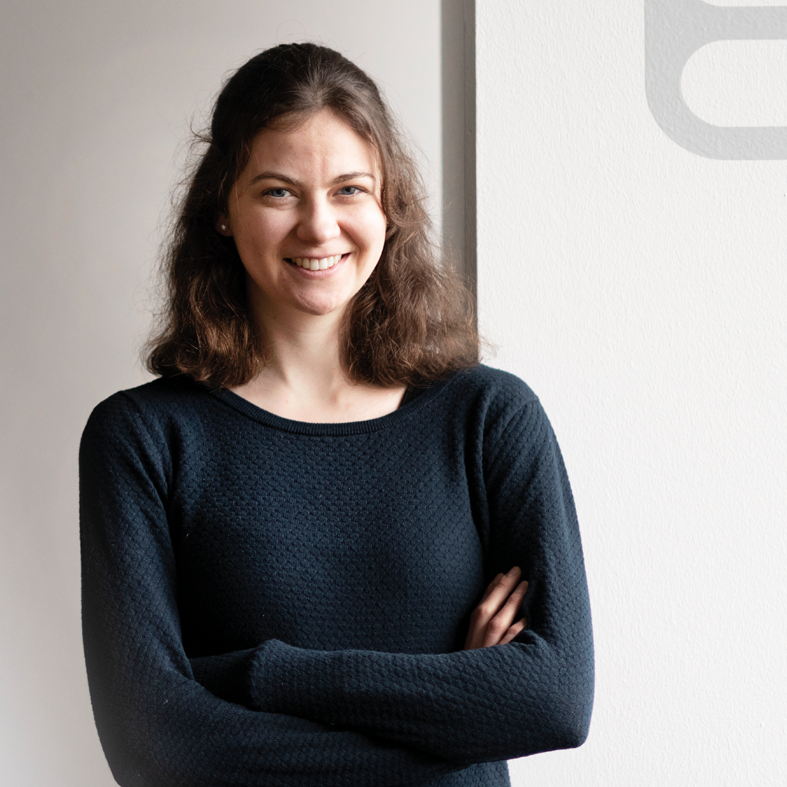
“I am fascinated by the many mysteries of modern physics, the measurements that the Standard Model of Particle Physics (SM) cannot fully describe. That’s why I work with effective field theories, because they allow us to explore physics beyond the SM at different energy scales, and they even allow us to search for novel, previously unknown particles without directly detecting them. I focus on axions and axion-like particles, or ALPs for short, which are not included in the Standard Model. ALPs can potentially explain many of the previously unsolved mysteries, including the absence of CP-violating effects in the strong interaction, one of the biggest open questions in Particle Physics.”
Basically, I dedicate myself to the search for ALPs from two sides: directly and indirectly.
In the direct search, the decay of charged kaons into a pion and an ALP is an insightful process that has not yet been observed. Since this process sets limits on the couplings of ALPs to the particles we know, it must be understood precisely. That’s why I wanted to calculate the so-called one-loop quantum corrections. To my surprise, however, the theory of this decay was not yet fully understood: important contributions were missing in the operator basis to be able to describe the experimental results consistently. My colleagues and I have now worked these out and recently published them.
In the indirect search, we use the fact that virtual quantum corrections from ALPs can have an influence on the theoretical prediction of measurement results, and a deviation between theory and experiment would be an indicator of new physics. An advantage of the indirect search is that, unlike the direct search, it is independent of the exact properties of the ALP, which are unknown to us, and can therefore also be used to constrain the ALP couplings.
I primarily calculate on the computer, but also classically with pen and paper. I find it particularly exciting how each solved puzzle usually gives rise to several new questions and research ideas, which I then try to answer together with my colleagues.”
Anne Galda has been a doctoral candidate in Prof. Dr. Matthias Neubert’s group and a Fellow of the Mainz Physics Academy of the Cluster of Excellence PRISMA+ since 2021. After her bachelor’s thesis within the IceCube experiment, she turned to the theoretical side of Particle Physics. She finds the answers to the puzzles that fascinate her through her calculations.
Photo: Jonas Werner Photography