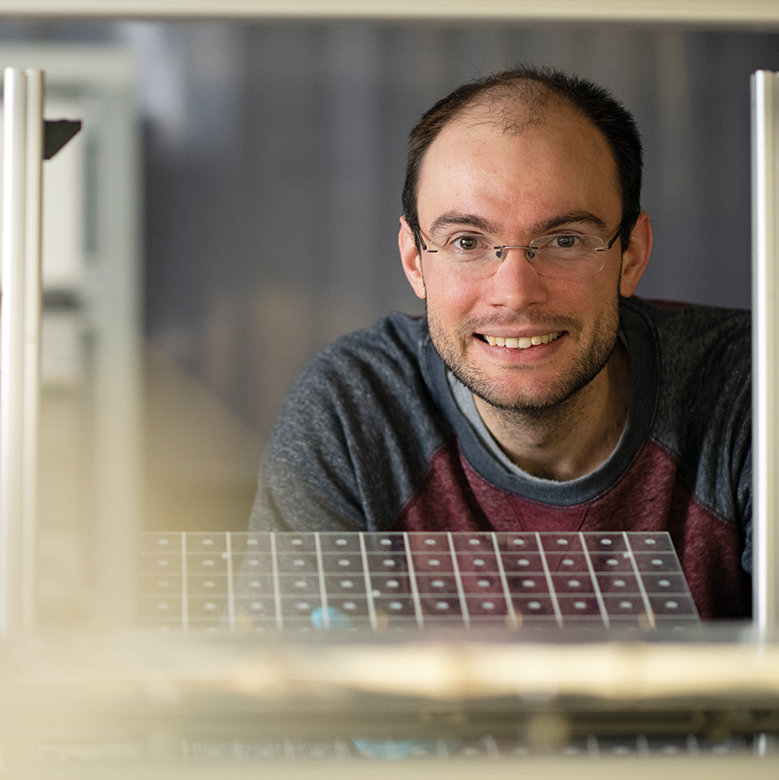
“How can we simplify the mechanical design of our detector?” This question marked the beginning of my postdoctoral researcher position in Mainz. As part of the CALICE collaboration, we aim to develop innovative calorimeters for future super-accelerators – for example, the International Linear Collider (ILC). Specifically, I am working on a highly granular hadronic calorimeter that can record particle tracks more accurately than ever before.
There was already a 1 cubic meter prototype, the mechanical construction of which was very challenging. One layer consisted of 144 scintillator tiles – each 3 x 3 centimeters in size – which had to be elaborately individually wrapped and glued together. Our idea: Can
we not work with one large tile instead of 144 small ones? And indeed: The new mega-tile is 36 x 36 centimeters in size, with individual segments created via drilled grooves filled with a special adhesive. Now it was necessary to process the top and bottom or edges of the tile in such a way that the whole system works reliably and precisely. That was a lot of systematic development work, but it paid off: With the same performance, we were able to extremely simplify the mechanical construction and assembly of a layer. I would call the result a functioning prototype.
It may be a while before our calorimeter can be used in a new accelerator. However, two experiments are already being considered to apply our beautiful design: The DUNE neutrino experiment, which is under construction, and an experiment called SHADOWS, which we want to propose for the SPS accelerator at CERN. My first visit to Mainz impressed me so much that it quickly became clear to me that I wanted to do research here as a postdoctoral researcher. The decisive factor was above all the great know-how and expertise in the detector laboratory – which offers almost unlimited possibilities.”
Dr. Antoine Laudrain is a postdoctoral researcher in the group of Prof. Dr. Volker Büscher. His academic path led him from Paris, where he earned a doctoral degree with a thesis on the ATLAS experiment, to Mainz. His next stop will be Hamburg.
Photo: Angelika Stehle